Archive for the ‘No Specific Topic’ Category

Updates on AIG

Wednesday, September 17th, 2008
Title : US launches AIG rescue loan to avoid market catastrophe
By :
Date : 17 September  2008 0952  hrs (SST)
URL : http://www.channelnewsasia.com/stories/afp_world_business/view/376493/1/.html
NEW YORK: The US Federal Reserve announced Tuesday it would make an unprecedented US$85-billion rescue loan to save insurance giant American International Group (AIG) from bankruptcy amid fears of a catastrophic meltdown on financial markets.

A central bank statement said the Federal Reserve Board made the decision “with the full support of the Treasury Department” under Section 13(3) of the Federal Reserve Act.

“The secured loan has terms and conditions designed to protect the interests of the US government and taxpayers,” the statement said.

All of AIG’s assets would be pledged to secure the loan while the Fed would retain a nearly 80-per-cent stake in the company, the Fed announced.

The move came after federal officials reportedly tried but failed to persuade private firms over the weekend to put up funds to save AIG.

With the vast insurance firm facing bankruptcy, Treasury Secretary Henry Paulson, Fed Chairman Ben Bernanke and Fed President Timothy Geithner decided that a federal lifeline was needed to prevent a disastrous fall-out in the financial markets.

The final decision came on Tuesday, as officials agreed it would be “catastrophic” to allow the company to fail, the Wall Street Journal reported, quoting an unnamed source familiar with the deal.

Paulson and Bernanke reportedly went to Capitol Hill late Tuesday to meet with top leaders of Congress, and an influential New York senator, Charles Schumer, confirmed a historic move was in the works.

“The administration is approaching an unprecedented step, but unfortunately we are living in unprecedented times,” Schumer said in a statement after meeting regulators about New York-based AIG.

“Hearing of these plans, you have to stop to catch your breath. But upon reflection, the alternatives are much worse,” said the Democrat, a member of the Senate Banking Committee.

Shares in AIG - a company with US$1 trillion in assets and tentacles in many markets - went on a roller-coaster ride on Tuesday, sliding 70 per cent at the open, swinging into positive territory and then closing down 21 per cent after a 60-per-cent plunge Monday.

New York Governor David Paterson earlier said AIG had one day to raise up to US$80 billion to stave off bankruptcy and avoid financial calamity.

In its first public statement since its shares went into a freefall on bankruptcy fears, AIG said earlier its insurance, retirement and other financial services were operating normally.

AIG said its businesses “including its extensive Asian operations, continue to operate normally and remain adequately capitalised and fully capable of meeting their obligations to policyholders.”

The statement added that AIG “continues to pursue alternatives to increase short-term liquidity in the parent company.”

David Kotok, chief investment officer at Cumberland Advisors, said earlier the US central bank had to act to avert a collapse at AIG that would be a calamity for markets - which went into shock after the Lehman Brothers’ bankruptcy Monday.

“This has the appearance of a cascade or a contagion. Failure of Lehman Brothers has created contagion because of counter-party risk that was not contained by the Fed,” Kotok added. “Failure of AIG will make this much worse.”

But Liz Ann Sonders, chief strategist at Charles Schwab & Co., said a Fed bailout might set a bad precedent. She said “other companies would undoubtedly look in the Fed’s direction for help.”

In blow after blow late Monday, the three main rating agencies - Standard & Poor’s, Moody’s and Fitch - lowered AIG’s credit score in a sign of solvency troubles for AIG.

Sonders said that according to AIG regulator filings, the rating cuts are likely to trigger up to 17 billion in collateral calls.

Far more than other insurers, AIG has been a big player in a complex parallel market called credit default swaps (CDS), financial instruments in which Wall Street companies take out a form of market insurance against the risks of bond default.

These products, often linked to the US real estate market, are at the heart of the current banking crisis and have led to massive write-downs of assets around the world.

AIG alone has written off US$25 billion amid spiking defaults on US mortgage payments in the United States.

- AFP/yb

Bill Gates to sign off at Microsoft

Saturday, June 28th, 2008

AFP - Saturday, June 28

SAN FRANCISCO (AFP) - - Bill Gates is spending his last day at Microsoft Friday before turning his attention full time to philanthropy after decades building the US software colossus.

The Microsoft co-founder, 52, known for his boyish face and nerdy manner, will now focus on running the Bill & Melinda Gates Foundation , aimed at fighting disease, reducing poverty, and improve education around the world.

Paul Allen, who teamed up with Gates to start Microsoft in a garage in 1975, will be among those “roasting” his childhood friend at a gala retirement dinner late Friday.

Gates began programming computers when he was 13 and a student living in the northwestern US state of Washington.

“Very early he demonstrated this really insatiable curiosity,” Gates’s father, William Gates Sr., said of his son in a video interview at the Microsoft website.

“He became a voracious reader. We knew he was smart, he was academically gifted, but we didn’t have any impression there was something world class going on in our living room necessarily.”

Gates and Allen were at the head of a small group of students that enjoyed working with the school’s computer, sometimes sneaking through a window to get to the machine after hours, said former teacher Bill Dougall.

School officials tapped into his programming prowess, swapping computer time for his services.

One tale is that Gates tinkered with school computer programming to put himself in classes made up mostly of girls.

Gates took his passion for knowledge to Harvard University in 1973.

“Bill was intense in college,” former college classmate Andy Braiterman said, listing academic subjects to which Gates was devoted.

“He was also very intense about pinball, Pong, Breakout (two early computer games) and most of all he was very intense about poker.”

At Harvard Gates met Steve Ballmer, who became part of Microsoft and was promoted to chief executive in 2000.

Gates recalls being in Harvard Square when Allen showed him a magazine cover story about a computer advancement, and thinking “This is happening without us and we are going to miss it.”

Gates, with the blessing of his lawyer father and teacher mom, left college after two years to start “Micro-soft” with Allen.

The duo bought the rights to existing computer software, modified it, got a copyright, and rechristened it Microsoft Disk Operating System (MS-DOS).

A key move by Gates was to focus on licensing software to computer makers in numerous “partnerships” that resulted in affordable machines being available to the masses.

In the early years at Microsoft, Gates reviewed every line of computer code and earned a reputation for not tolerating slow thinking.

Gates challenged developers with comments such as “I could write that over the weekend,” according to original Microsoft employee Steve Wood.

“He kept people on their toes,” Wood recalled. “We accomplished things that we otherwise never would have figured out we could have done.”

Microsoft’s slogan was “A computer on every desk and in every home” — using, of course, its software.

“In the mid-1980s that was still a kind of crazy thing,” said former Microsoft chief technology officer Nathan Myhrvold.

“It went in a very short time from ‘It’s insane that everyone would have a computer to ‘My God, of course everyone needs to have a computer.”

Today more than 90 percent of the world’s computers run on Microsoft software.

Gates eases into retirement ranked the third richest person in the world, behind US investor Warren Buffet and Mexican tycoon Carlos Slim.

Gates and his wife, Melinda, live in an earth-friendly “smart home” on a swath of hillside overlooking a lake near Microsoft headquarters in Redmond, Washington. The couple married in Hawaii in 1994 and has three children.

While seemingly aloof, Gates has a humorous side.

There are photos of him prancing in a superhero costume at a company party, and he made a comic “Bill’s Last Day at Work” video that has gotten thousands of views on YouTube.

After leaving Microsoft, Bill Gates will remain its largest single shareholder and chairman of company’s board of directors.

Limited Edition Manchested United Movie Discount Card

Wednesday, June 25th, 2008

Want to own one of this Limited Edition Movie Cards?

 Read the attachment for more information or send an email to enquiry@aia.com.sg. Alternatively, you may call +65 6100 4888 with your queries.

mu-brochure.pdf

Chee and sister get jail for contempt

Wednesday, June 4th, 2008

Business Times - 03 Jun 2008

SDP DAMAGES HEARING
 

By MICHELLE QUAH

(SINGAPORE) The High Court has sentenced Singapore Democratic Party (SDP) chief Chee Soon Juan to 12 days’ jail, and his sister Chee Siok Chin to 10 days, for contempt of court.

The Chees have until Wednesday evening to file a notice of appeal, failing which they will have to turn themselves in on Thursday morning.

The sentence, handed down by Justice Belinda Ang yesterday, is the harshest reported in Singapore for such an offence.

The Chees were judged to be in contempt for their ’scandalising and insulting behaviour directed at the court, and in particular, attacks on the court’s impartiality’, during a hearing last week to determine damages they should pay for defaming Prime Minister Lee Hsien Loong and Minister Mentor Lee Kuan Yew in 2006.

In mitigation, lawyer M Ravi said yesterday his client Ms Chee had no desire to scandalise the court.

‘(My client), in the face of a series of defeats, became almost paranoid in believing that the system was against her,’ he said. ‘And in the heat of the judicial proceedings … any verbal utterances would inevitably reflect the deep-seated fear and anxiety. The real cause (of her outbursts was) fear borne of successive defeats.’

Ms Chee represented herself at the damages hearing. And Mr Ravi said that lacking the proper training, she could not be expected to ‘understand the legal parameters of relevance’.

He said she was understandably anxious cross-examining ‘the Prime Minister of the country and his father, who happens to be at the helm of the core of political power of one’s nation’.

He also pointed out that Ms Chee was in physical pain during the proceedings, as she has a tooth infection.

Justice Ang noted Mr Ravi’s submissions but said: ‘Misbehaviour in court, if unpunished, will very much diminish the dignity and authority of the court, and that would not be in the public interest.’

She sentenced Ms Chee to 10 days’ jail but agreed to suspend the sentence on condition Ms Chee files an appeal by Wednesday evening.

Dr Chee was represented by veteran politician JB Jeyaretnam, who began by saying the court would recognise that he ‘does not have to agree with whatever has been done by the client’ but that he nevertheless has a duty.

Mr Jeyaretnam then asked if Justice Ang should be hearing the case, ’seeing that the contempt of court charges, the allegations, proceeded in (your) court and arose out of exchanges between the court and the defendant’.

‘I am not alleging in the slightest way any bias on you. All I’m asking you to consider is the public perception,’ he said.

Justice Ang disallowed the application, saying: ‘What was observed and heard by me could not be fully appreciated from a mere reading of the transcripts or from listening to the recordings.’

Mr Jeyaretnam then asked for two more weeks to prepare his case - which Justice Ang denied.

When Mr Jeyaretnam returned after a short break, he informed the court that Dr Chee had discharged him ‘because he (Dr Chee) concedes that I have had no time to prepare the case … and so he wants to spare me the embarrassment’.

Dr Chee then addressed the court briefly, saying he never intended to be in contempt of court or to scandalise the court. ‘Very many political arguments were made. And in the heat of the battle, (MM) Lee had said a few things. I had countered him,’ Dr Chee said.

Justice Ang said his behaviour during the hearing ‘amounted to acts which scandalised the court and adversely affected the administration of justice and impugned the dignity and the authority of the court’.

She found him in contempt of court and sentenced him to 12 days’ jail - pending an appeal by Wednesday evening.

Mrs Lee Kuan Yew making steady progress

Wednesday, June 4th, 2008

Business Times - 02 Jun 2008
 

By ARTHUR SIM

MRS Lee Kuan Yew, wife of Minister Mentor Lee Kuan Yew, is making steady progress after suffering a stroke on May 12.

A press statement from the Minister Mentor’s Office issued yesterday said: ‘Twenty days after suffering a stroke, Mrs Lee’s condition has stabilised.’

Mrs Lee, 87, had experienced sudden weakness in the left side of her body and slurring of speech. She was taken to the National Neuroscience Institute (NNI) for an urgent brain scan, which revealed bleeding in the right side of the brain, and was subsequently admitted to the Neurointensive Care Unit in Tan Tock Seng Hospital.

After her transfer to the general ward on May 14, Mrs Lee remained in serious condition and underwent surgery on May 17.

The statement from the Minister Mentor’s Office yesterday also said: ‘Since her surgery, she has become more alert, and is currently making slow but steady progress with rehabilitation.’

This is the second stroke that Mrs Lee is reported to have suffered.

In 2003, when she and Mr Lee were in London on a European tour, she also suffered a stroke. She recovered soon after and was well enough to continue accompanying Mr Lee on official trips.

Their last official trip is said to have been in March when they visited Saudi Arabia, Dubai and Bahrain in the Middle East.

NTUC Income rules out option to stay in old bonus scheme

Wednesday, June 4th, 2008

Business Times - 30 May 2008
 

By GENEVIEVE CUA

IN his plainest statement yet on a controversial bonus cut, NTUC Income chief executive Tan Suee Chieh said yesterday the move is the right decision and policyholders will not be given an option to remain in the old bonus scheme.

Income announced last month that it would cut its annual bonus payouts for participating plans from 2.3 to 1.3 per cent and raise its special or terminal bonus rates from 25 per cent to between 30 and 120 per cent.

tkl.jpg

That move has raised the ire of its former chief executive Tan Kin Lian, whose postings in his blog have galvanised other policyholders.

News reports this week said Mr Tan Kin Lian was calling a truce in his protest. But a letter from him in The Straits Times yesterday said he disagreed with Income’s view that the old bonus rate was unsustainable. He said the actual yield earned by the life fund was higher than the projected yields at point of sale.

In a statement yesterday ahead of Income’s annual general meeting, Mr Tan Suee Chieh said Income’s board has ‘recognised’ that its financial position had to be strengthened since August 2006. The issue was ‘extensively discussed’ last year.

He said an appointed actuary’s opinion was that under the old structure, Income would be less likely to meet policyholders’ payouts and would end up with a weaker financial position.

‘The old structure was not sustainable and would undermine our ability to deliver total returns, which are ultimately more important to policyholders,’ Mr Tan Suee Chieh said. ‘There is now a better chance for NTUC Income to not only deliver returns as illustrated to policyholders, but to deliver even better returns.’

He also said the new bonus structure will reduce the likelihood of bonus cuts in the future.

While Income’s life fund has generated a total annualised return of about 7.8 per cent over the past 10 years, that is understood to comprise income and capital gains. The fund is understood to generate a running yield of between 2 and 3 per cent.

It is also understood that the old structure would have needed a running yield of 4.5 per cent a year to sustain the old bonus rates.

The new bonus structure is expected to release some $70 million of capital. This is expected to grow to $400 million over a few years to give Income greater flexibility in terms of investments.

Under the risk-based capital regime, high bonus rates will require high capital reserves, as bonuses once declared are guaranteed. Income has a capital adequacy ratio of about 180 per cent. And while well above requirements, it is one of the lower ratios in the industry.

Nick Dumbreck, president of the UK Institute of Actuaries, who also acted as consultant to Income, said: ‘Most policyholders’ main concern is with what they get back from the policy when it matures or is surrendered. The level of guarantee is secondary.

‘The level of guarantees has to be managed so that the exposure to equities can be sustained. That may mean cutting the annual bonuses. It is better to take action in advance of a problem arising. Once investment conditions become difficult, it can be too late to do anything.’

Mr Dumbreck said the ‘normal’ practice in the UK is to adjust the level of the final bonus and the annual bonus remains stable. ‘Normally the level of the regular bonus is set with reference to interest rates and bond yields,’ he said.

‘If bond yields remain stable, equity returns shouldn’t influence the annual bonus level. Normally you’d expect the final bonus to vary rather more from year to year to reflect the level of equities subject to smoothing.’

Singaporeans, suit up to skydive in Sentosa soon

Thursday, May 22nd, 2008

Business Times - 16 May 2008
 

EXTREME sports enthusiasts and adventure seekers will soon be able to experience the adrenaline-pumping sport of skydiving at an affordable price, when the world’s largest vertical wind tunnel opens in Sentosa during the second quarter of 2009.

ifly.jpg

The skydiving simulator, iFly Singapore, is slated to open to members of the public aged three years and above and will cost $40 for a half-hour experience in the wind tunnel.

Built by Singapore franchise SkyVenture Singapore, iFly Singapore will cost at least $16 million and measures five metres in diameter with a flying height of 17 metres.

Flyers can expect to see the view of the South China Sea and Sentosa’s Siloso Beach while in the transparent wind tunnel.

Managing director of iFly Singapore Lawrence Koh said: ‘As the public has no access to a parachute drop zone in Singapore, iFly Singapore will offer anyone from amateurs to professionals the chance to skydive in a safe, realistic and affordable indoor setting.

‘The simulator will play a key role in promoting this unique sport in Asia while attracting world-class skydivers and international skydiving events to Singapore.’

New state-of-the-art technology such as electronic coding wrist bands to recognise flyers’ profiles and real-time video and photo uploads will be incorporated into iFly Singapore.

Latest innovations in safety such as electronic sensors and biometric security locks will also be used to ensure the safety of the flyers.

Sentosa’s latest attraction is expected to draw more crowds to the island and diversify the activities available to its visitors.

‘Interactive, high energy, thrilling are buzzwords among many people of different ages now. iFly Singapore will certainly score well in Sentosa’s vibrant, sporty zone on Siloso and add a new pulse to the adventure scene on the island,’ commented Goh Lye Whatt, director of property, planning and development in Sentosa.

Mrs Lee Kuan Yew suffers brain haemorrhage

Thursday, May 22nd, 2008

Business Times - 16 May 2008
 

MRS Lee Kuan Yew suffered a massive brain haemorrhage on Monday and was admitted to Tan Tock Seng Hospital after a scan at the National Neuroscience Institute, the Prime Minister’s Office said in a statement last night.

The statement said the haemorrhage stabilised after two days of monitoring and treatment. Mrs Lee, 87, was transferred to a general ward on Wednesday.

‘Currently, she remains in a serious condition, although she is able to recognise family members,’ the statement said.

Kelvin - I sincerely wish Mrs Lee and her family peace and comfort…

4 bungalows sold for $5.5m each

Thursday, May 22nd, 2008

Business Times - 15 May 2008
 

$22 million transaction works out to $1,128 psf of built-up area

By KALPANA RASHIWALA

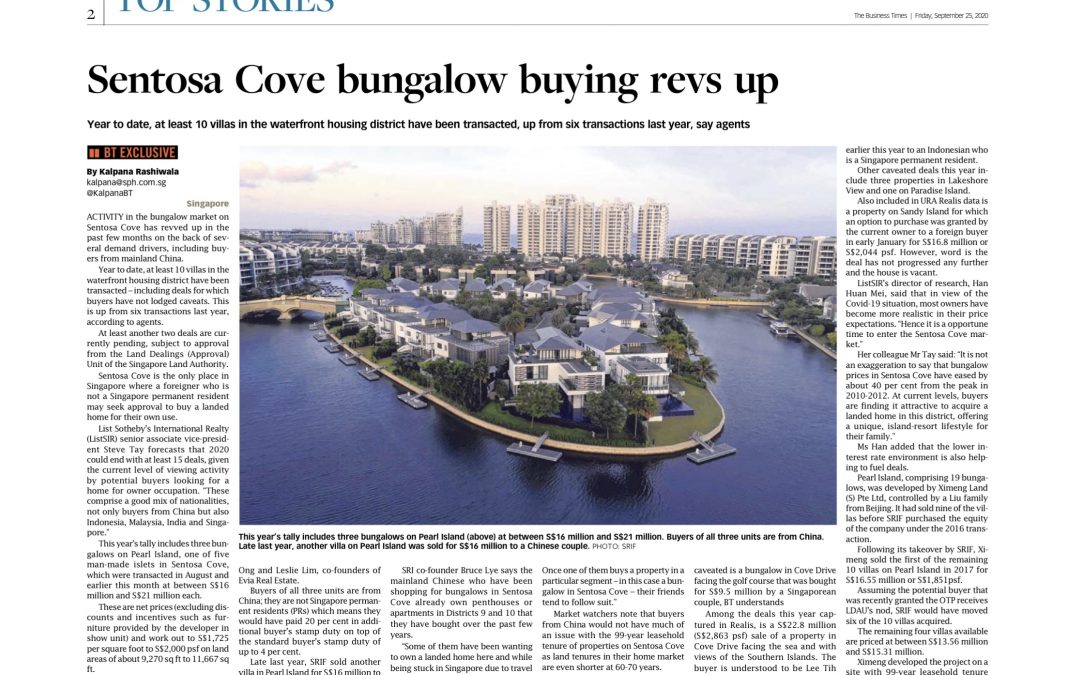
AMID the current quiet residential market, some deals are still being stitched up.All four strata bungalows in a freehold cluster housing development near Eng Neo Avenue were snapped up at $5.5 million each at a preview on Friday last week by a European with a Singaporean wife.

quartet.jpg

The $22 million transaction works out to $1,128 psf of built-up area. ‘The units were bought partly for the buyers’ own use and partly for investment,’ said Jerry Tan, managing director of JTResi, the sole marketing agent for Quartet on Vanda. JTResi previewed the development over a ‘champagne supper’ at its premises on Club Street May 9 evening and the four units were sold during the course of the evening.

The bungalows, which are expected to be completed early next year, are being developed by Stanley Quek’s Region Development on a 12,300 sq ft site at Vanda Crescent off Dunearn Road. Each two-storey unit has an attic, a basement and a swimming pool. Built-up areas range from 4,844 sq ft to 4,919 sq ft.

‘The market is not as dead as people may perceive it to be. For better quality developments that are priced sensibly, there will be buyers,’ Mr Tan said.

Dr Quek is also developing a couple of conventional bungalows on the next-door plot which will come on the market soon, Mr Tan revealed. Each two-storey bungalow will have an attic and have a land area of about 5,000 sq ft.

JTResi, a seven-year-old boutique residential property consultancy, has also been quietly doing resale and leasing deals at The Grange, which received its Temporary Occupation Permit a couple of months ago. ‘About four weeks ago, we sold the penthouse at The Grange for $11 million to a Singapore PR who is from mainland China,’ Mr Tan revealed. The deal for the 4,400 sq ft duplex unit worked out to just under $2,500 psf and the seller had bought it from the developer for about $6.8 million in 2005, according to Mr Tan.

JTResi also recently brokered leasing deals in the development at a monthly rental of $15,000 for a three-bedroom apartment of 1,765 sq ft below the penthouse, and four-bedroom, pool-facing unit on a low floor at $16,000.

The Grange comprises two freehold blocks of 19 and 23 storeys.

Cushman & Wakefield last month also brokered the sale of a four-bedroom unit on the 17th floor of The Grange for $6.2 million or $2,692 psf. The buyer is a Singapore PR who is believed to have invested in other luxury apartments here.

The seller had bought the unit (in the subsale market) for $4.15 million or $1,801 psf in late 2006. ‘The vendor made a cool $2 million profit after holding the asset for 1.5 years. Due to the run-up in prices in the last 12 months, some vendors have made enough ‘paper gains’ to realise a decent profit even if they sell at today’s prices,’ said Cushman managing director Donald Han.

Mr Han estimates The Grange unit his firm sold recently might have fetched just under $3,000 psf had it changed hands last year when sentiment was stronger. ‘Generally, there’s support for prime residential properties which appeal to foreign investors and where yields are fairly attractive,’ he added.

AIG posts US$7.8b Q1 loss; CEO’s job at risk

Saturday, May 17th, 2008

Business Times - 10 May 2008
 

(NEW YORK) American International Group (AIG) will seek to raise US$12.5 billion to shore up its finances after two straight record losses, adding to speculation that Martin Sullivan may be the next chief executive officer to lose his job amid the global credit crisis.

AIG, the world’s biggest insurer by assets, posted a first-quarter net loss of US$7.81 billion on Thursday compared with earnings of US$4.13 billion a year earlier. AIG disclosed more than US$15 billion in pretax writedowns.

Shareholders are chafing at AIG’s 24 per cent drop this year, which came after Mr Sullivan, 53, reassured them in December that writedowns would be ‘manageable’. The New York-based insurer has since reported more than US$19 billion in losses from contracts sold to protect fixed-income investors and said more are possible, causing analysts to question how much longer Mr Sullivan’s three-year tenure as CEO will last.

‘Management capability issues, which have been smouldering for a while, are likely to flare up,’ David Havens, a credit analyst at UBS in Connecticut, said in a report to investors. ‘One of AIG’s constant weaknesses has been its complexity. It’s come back to bite them.’

AIG wrote down contracts it had sold to protect investors by US$9.11 billion in the first quarter to comply with rules that require the company to estimate their present market value. Mr Sullivan said as recently as March that those losses were temporary, and the actual amount in a worst-case scenario might be US$900 million over a period of years. On Thursday, AIG said the losses might reach US$2.4 billion.

The loss of US$3.09 a share, reported after the market’s close on Thursday, was four times worse than Wall Street analysts had expected.

The venerable insurer now joins the ranks of other industry giants that have suffered huge losses because of the recent tumult in the financial markets. This is the first time AIG has lost money in two consecutive quarters.

Despite the painful quarter, the company plans to raise its dividend by 10 per cent - half its usual increase - which will cost an additional US$202 million on an annualised basis.

The company’s chief executive admitted that AIG badly underestimated the extent of the problems in the credit market.

‘The severity of the unrealised valuation losses and decline in value of our investments were beyond our expectations,’ Mr Martin wrote.

Mr Sullivan, who took over his post in early 2005, wrote that the dismal results ‘do not reflect the underlying strengths and potential of AIG’. He blamed the ‘extremely adverse external conditions’ in the housing and credit markets, but defended the performance of his company’s core insurance business.

A year ago, AIG appeared in solid shape. The company reported a profit of US$4.13 billion in the first three months of 2007, or US$1.58 a share.

But in trying to expand its fortunes, the company placed big bets on an arcane corner of the fixed-income market, where companies traded sophisticated instruments known as credit default swaps.

For awhile, those swaps rewarded investors with enormous returns. But as securities tied to sub-prime mortgages began to collapse and a growing crisis of confidence spread throughout the nation’s financial structure, the instruments rapidly lost their value.

The result for AIG was, in the words of one analyst, ‘gruesome’: its assets lost US$9.11 billion in value in the first quarter alone.

That hit, coupled with a US$6.82 billion loss on investments, decimated the company’s bottom line.

AIG, which still holds those battered assets, is hoping that the market for credit default swaps improves in coming months\. \– Bloomberg, NYT