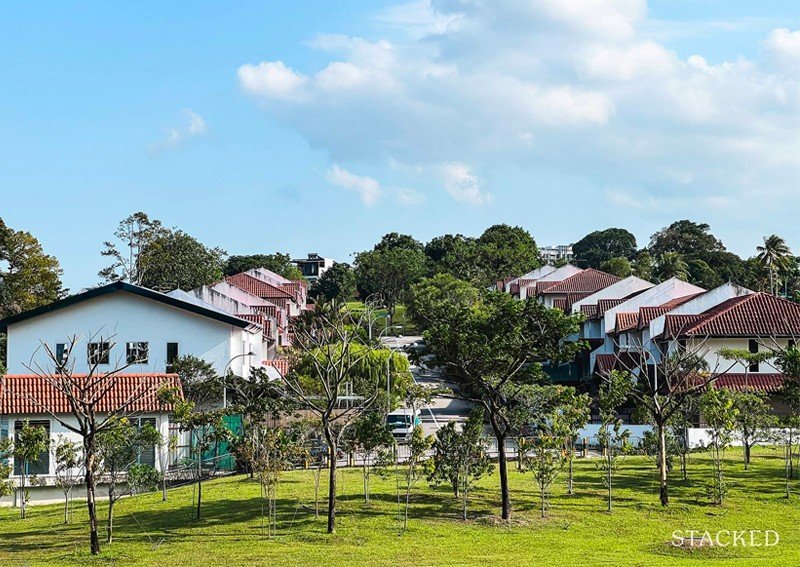
4 bungalows sold for $5.5m each

Written by Kelvin on May 22, 2008 – 3:55 pm -

Business Times - 15 May 2008
 

$22 million transaction works out to $1,128 psf of built-up area

By KALPANA RASHIWALA

AMID the current quiet residential market, some deals are still being stitched up.All four strata bungalows in a freehold cluster housing development near Eng Neo Avenue were snapped up at $5.5 million each at a preview on Friday last week by a European with a Singaporean wife.

quartet.jpg

The $22 million transaction works out to $1,128 psf of built-up area. ‘The units were bought partly for the buyers’ own use and partly for investment,’ said Jerry Tan, managing director of JTResi, the sole marketing agent for Quartet on Vanda. JTResi previewed the development over a ‘champagne supper’ at its premises on Club Street May 9 evening and the four units were sold during the course of the evening.

The bungalows, which are expected to be completed early next year, are being developed by Stanley Quek’s Region Development on a 12,300 sq ft site at Vanda Crescent off Dunearn Road. Each two-storey unit has an attic, a basement and a swimming pool. Built-up areas range from 4,844 sq ft to 4,919 sq ft.

‘The market is not as dead as people may perceive it to be. For better quality developments that are priced sensibly, there will be buyers,’ Mr Tan said.

Dr Quek is also developing a couple of conventional bungalows on the next-door plot which will come on the market soon, Mr Tan revealed. Each two-storey bungalow will have an attic and have a land area of about 5,000 sq ft.

JTResi, a seven-year-old boutique residential property consultancy, has also been quietly doing resale and leasing deals at The Grange, which received its Temporary Occupation Permit a couple of months ago. ‘About four weeks ago, we sold the penthouse at The Grange for $11 million to a Singapore PR who is from mainland China,’ Mr Tan revealed. The deal for the 4,400 sq ft duplex unit worked out to just under $2,500 psf and the seller had bought it from the developer for about $6.8 million in 2005, according to Mr Tan.

JTResi also recently brokered leasing deals in the development at a monthly rental of $15,000 for a three-bedroom apartment of 1,765 sq ft below the penthouse, and four-bedroom, pool-facing unit on a low floor at $16,000.

The Grange comprises two freehold blocks of 19 and 23 storeys.

Cushman & Wakefield last month also brokered the sale of a four-bedroom unit on the 17th floor of The Grange for $6.2 million or $2,692 psf. The buyer is a Singapore PR who is believed to have invested in other luxury apartments here.

The seller had bought the unit (in the subsale market) for $4.15 million or $1,801 psf in late 2006. ‘The vendor made a cool $2 million profit after holding the asset for 1.5 years. Due to the run-up in prices in the last 12 months, some vendors have made enough ‘paper gains’ to realise a decent profit even if they sell at today’s prices,’ said Cushman managing director Donald Han.

Mr Han estimates The Grange unit his firm sold recently might have fetched just under $3,000 psf had it changed hands last year when sentiment was stronger. ‘Generally, there’s support for prime residential properties which appeal to foreign investors and where yields are fairly attractive,’ he added.


Posted in No Specific Topic, Real Estate in Singapore | No Comments »

St Regis, Singapore

Written by Kelvin on April 28, 2008 – 3:19 pm -

Business Times - 26 Apr 2008
 

By CORINNE KERK

IF YOU’RE really, really too time-strapped to spare a three or four-hour flight out of Singapore, there’s the St Regis: for the waited-on-hand-and-foot experience.

St Regis is the only hotel in Singapore to offer butler services to all guests now that it’s open.

For some folks, this service takes some getting used to. For example, even though your butler says to call him if you need anything at all, should you do so if you can’t find sanitary bags in the impressive marble sanctuary that is the loo? What about calling him for a different pillow when the one on your bed gives you a neck ache in the middle of the night?

For others, however, the butler is a dream come true. Hate packing and unpacking whenever you travel? No problem, buzz the butler. Want to read international newspapers? Sure thing, the chap will get them for you.

Heck, your plush room doesn’t even come with a coffee/tea maker because the butler will make your cuppa, 24/7.

So yes, it is a charmed life when you check into the St Regis, where you’ll find little need to raise a finger unless it is to press the butler call button. That leaves you with plenty of energy to enjoy your surroundings.

stregis.jpg

At the posh hotel, a collection of over 40 original art pieces by such familiar names as Fernando Botero, Marc Chagall and Frank Gehry dot the public areas, while its 299 rooms and suites ooze quiet opulence through tasteful, stately decor.

stregisi.jpg

For a room with a nice, unblocked view, ask for a Tanglin Road facing one on a high floor. But if you want to check out the apartments in the posh St Regis Residences, the Cuscaden Road facing rooms will give you a pretty good peek.

Facilities-wise, there is a rather narrow swimming pool, a top-class fitness centre and an air-conditioned tennis court. But nothing beats the hotel’s much-talked about Remede Spa. Sure, its treatments are wonderful, but it is Remede’s luxurious wet lounge that really raises the bar as far as exceeding guest expectations goes. Suffice to say you will find yourself wanting to try every heated marble surface, dip into every body of water and pop into every steamy chamber.

Filling your tummy, however, is just as pleasurable. Theoretically, you could work your way through the all-day dining restaurant, Les Saveurs, for breakfast; the poolside Mediterranean eatery, LaBrezza, for lunch; then tuck into afternoon tea at the Drawing Room before finishing up with dinner at the Cantonese restaurant, Yan Ting.

But if that doesn’t work out, then at the very least, make sure you go for the wine tasting at the Decanter wine bar in the evening. Staying guests are invited to taste four wines - compliments of the hotel’s chief sommelier - but the bonus is the sommeliers’ personable company in a very chic atmosphere.

For a spot to wind down the evening - and feel smug as you look out at the hoi polloi on Tanglin Road - head to Astor Bar for a Chilli Padi Mary. If the concoction doesn’t knock you senseless, it will at least make you happy to be alive - and staying at the St Regis.

The St Regis Singapore is at 29 Tanglin Road.
Tel: 6506 6888, website: StRegis.com/Singapore


Posted in New Launches | No Comments »

HDB resale transactions decline 6% in Q1

Written by Kelvin on April 28, 2008 – 3:15 pm -

Business Times - 26 Apr 2008
 

Median COV was $21,000, compared to $22,000 in Q407

By EMILYN YAP

TRANSACTIONS of resale HDB flats fell 6 per cent from the fourth quarter of 2007 to 6,360 in Q1 this year, against the backdrop of rising asking prices and high cash-over-valuation (COV) demands.

‘With escalating resale prices and more and more COV transactions, we saw the resale market hit resistance in Q4 last year as HDB flat buyers do not have or are not willing to part with so much cash,’ said property agency ERA’s assistant vice-president Eugene Lim. ‘This resistance carried through to the first quarter this year.’

In Q4 2007, a total of 6,750 resale flats changed hands, which was itself a 13 per cent drop from Q3 2007.

slide.jpg

HDB’s resale price index rose 3.7 per cent in Q1 this year compared with Q4 2007.

But this increase was lower than the 5.7 per cent quarter-on-quarter rise in Q4 2007.

The median COV of all resale flats in Q1 this year was $21,000, slightly down from $22,000 in Q4 2007.

In some estates, the drop was much larger.

The median COV of executive flats in Bishan, for instance, plunged $25,000-$45,000 in Q1 2008, and that of five-room flats in Marine Parade fell $15,000-$50,000.

On the resale price trend, PropNex CEO Mohamed Ismail believes an increase is sustainable in the long term and that double-digit growth this year is attainable, given the robust economy.

Mr Ismail reckons the falling COV reflects a smaller number of private property and en bloc downgraders in the market.

He expects the COV to stabilise at $20,000 islandwide for the year, as demand for resale flats increases and the number of surplus flats falls.

ERA’s Mr Lim also expects the resale market to remain healthy for the rest of the year, though price growth may be more measured.

‘For the whole year, we do not expect resale prices to increase more than 10 per cent,’ he said.

He noted that some demand for resale flats may be diverted to the increasing number of new flats coming on stream.

‘First-timers and those that can wait a couple of years are likely to go for new flats, as buying direct from HDB involves little or no cash outlay,’ he said.

HDB said yesterday it plans to offer 5,000 new flats under the Build-To-Order (BTO) system during the next six months.

Together with 1,100 launched in Q1, the planned BTO supply of 6,100 new flats for January to September will exceed the numbers of BTO flats launched in 2007 or 2006, which were 6,000 and 2,400 respectively.


Posted in Real Estate in Singapore | No Comments »

Homes held back from launches in staring game

Written by Kelvin on April 28, 2008 – 3:01 pm -

Business Times - 26 Apr 2008
 

Buyers not forthcoming, so developers delay projects that are ready for market

By ARTHUR SIM

(SINGAPORE) The number of homes that could be launched for sale immediately, but have been held back, has increased to 10,239 in the first quarter of 2008, an increase of 44.2 per cent over the 7,099 units in the fourth quarter of last year. This, perhaps, is a reflection of the standoff between developers and buyers.

The Urban Redevelopment Authority’s (URA) property data for the quarter also revealed that there were 2,526 homes launched, but unsold at the end of the first quarter of 2008, an increase of 22.4 per cent over the previous quarter.

CB Richard Ellis director Leonard Tay said simply: ‘As homebuyers were less forthcoming, developers decided to delay their launches.’

ww.jpg

Mr Tay highlighted that most of the new projects launched were small projects located outside the prime residential districts. ‘The only project targeted at the mass market, the 405-unit Waterfront Waves at $800 psf (per square foot), met with a certain degree of success as evidenced by the 108 units sold,’ he added.

According to URA, prices of private residential property increased by 3.7 per cent in Q1 2008 compared to 6.8 per cent in the previous quarter.

Mr Tay said that while there were no new luxury projects launched, a few units from existing projects were known to have been sold at above $3,300 psf in Q1 2008, with several units in Marina Collection sold at above $2,600 psf.

‘These, and probably some high-priced transactions in the resale and sub-sale markets, could have contributed to the 3.7 per cent rise to the private residential price index from the previous quarter,’ he added.

Interestingly, the 3.7 per cent increase in the PPI is lower than the earlier forecast of 4.2 per cent.

URA said that the last time the flash estimate of the change in private residential property price index (PPI) was revised downwards by more than 0.5 per cent points was in Q4 2001, when it was pegged downwards by 1.4 percentage points.

Jones Lang LaSalle local director and head of research (South-east Asia) Chua Yang Liang also noted that PPI was down by 3.1 percentage points from the 6.8 per cent growth recorded in Q4 2007, the biggest quarterly drop since Q3 2000, when prices declined by 4.2 percentage points.

Dr Chua said that overall, developers remained conservative on their new launches.

But while there was a significant growth in Outside Central Region (OCR) where a total of 813 units were released in the quarter - 60.5 per cent of total launches in Singapore in Q1 2008 - he noted: ‘Demand in this region was however not as strong.’

Take-up rate for OCR was only 38 per cent whereas Core Central Region (CCR) and Rest of Central Region (RCR) reported healthier take-up rate of 89 per cent and 71 per cent respectively.

And Cushman & Wakefield managing director Donald Han believes buyers are prepared to wait. ‘Property is sentiment-driven, and if buyers believe the economy will slow down, they will be prepared to wait it out on the sidelines,’ he said.

The disappearance of speculators from the market may have also dampened sales, as reflected by the lower number of subsales at just 346 transactions, down from 649 in the previous quarter.

‘Short-term speculators have been weeded out,’ Mr Han said. But, as Mr Han notes, it is now also ‘a smaller market’.

Savills Singapore director (marketing and business development) Ku Swee Yong also believes sub-sales have reached a plateau with current data ‘reflecting true demand’.

According to Savills’ own basket of properties launched and sub-sold in 2007 and 2008, the level of subsales fell from 34 transactions in Q4 2007 to just six transactions in Q1 2008. Subsale prices, however, remained stable, suggesting that panic selling for the time being at least is unlikely.

On whether the increasing backlog of unsold homes could pose a potential over-supply situation in the future, Mr Ku said that he believes not all the potential developments will be built.

URA projects that 56,501 units are expected to be completed between Q2 2008 and 2011, of which 29,685 units are already under construction.

Mr Ku said there are certain ‘control mechanisms’ which could see a lower number of units completed by 2011 with the first being the construction factors. Mr Ku said that a project that has not already begun construction is not likely to be finished within two years, simply because of the costs and shortages within the construction industry currently.

Another control mechanism lies with developers. ‘In the previous downturn, some developers held off projects for 10 years,’ he said.


Posted in Real Estate in Singapore | No Comments »

Pender Court en bloc sale fails, owners keep $12m

Written by Kelvin on April 26, 2008 – 6:19 pm -

Business Times - 25 Apr 2008
 

Deal called off as buyer decides to cut losses on investment

By KALPANA RASHIWALA (SINGAPORE) The sale of Pender Court off West Coast Highway to a unit of Bravo Building Construction has been called off. The buyer failed to complete the transaction by paying the remaining $72 million that it owed the sellers on the purchase price.

pc.jpg

Owners of the 48 units will keep the $12 million, or an average of $250,000 per unit, they have received so far from the associated Bravo company, Pender Development Pte Ltd.

A Bravo spokeswoman told BT yesterday that the group decided to cut its losses on the investment so far rather than pump in more money as the venture was no longer profitable, given the bad publicity the company had been receiving lately from the rescission of two other en bloc sales to Bravo units - those of Tulip Garden in Holland Road and Makeway View in the Newton area.

Also, a party that was to buy an entire proposed 50-unit cluster housing project to be developed on the Pender Court site pulled out at the end of last month. ‘My breakeven cost would have been about $2.7 million per cluster house. My purchaser withdrew. With the bad publicity that we currently have, I don’t think the project can even fetch $2.3 million to $2.5 million per unit if I were to launch the development now,’ said a Bravo spokeswoman.

‘So we’d lose money. We might as well cut our loss now - I’ve lost $12 million - rather than make a bigger loss by pursuing the redevelopment.’

Even if Bravo had pursued its original plan to build a condo on the Pender Court site, the breakeven cost would be about $1,300 to $1,400 psf today, which would not be viable in the current market, the spokeswoman said.

BT understands that the $12 million that Pender Development has paid Pender Court’s owners comprised two initial deposits of $4 million each - on the $80 million price - and a further $4 million that the buyer paid the owners for the latest extension. The deadline to complete the transaction ended yesterday.

Pender Court’s $80 million en bloc sale was announced in July last year, which is when the Bravo associate paid an initial 5 per cent deposit. When the collective sale was approved by Strata Titles Board on Nov 21 last year, the Bravo associate paid the second 5 per cent deposit.

The completion date, which is when the remaining 90 per cent of the purchase price must be paid up, was to have been in late February. However, when this was not completed, the owners’ lawyer served a notice advising the Bravo associate that if it does not complete the purchase within 14 days, the owners would rescind the deal. Before the 14 days ran out around mid-March, Bravo asked for an extension to April 24 and paid the owners a further $4 million on top of the original $80 million purchase price.

All $12 million have been disbursed to the owners, BT understands.

No further notice of rescission is required under a supplementary agreement signed seeking the extension until yesterday.


Posted in En-Bloc! | No Comments »

Property price data can yield different conclusions

Written by Kelvin on April 26, 2008 – 6:13 pm -

Business Times - 24 Apr 2008

NEWS ANALYSIS
 

Same figures in flash estimate of property prices can be read very differently

By ARTHUR SIM

THE property price index (PPI) for the first quarter of 2008 will be released soon - and is unlikely to differ from an earlier flash estimate of a 4 per cent increase, despite developers starting to cut prices for new projects.

So how useful is the PPI? Does data overload cause confusion?

index.jpg

Last week, The Straits Times headline for the story on the flash estimate was ‘Private homes sales recover in weak market’. In The Business Times, the headline was ‘Private home sales tumble, prices weaken’.

As confusing as it sounds, both headlines were technically correct.

One reason could be how data is interpreted and the level of optimism or pessimism - the same figures can be read very differently.

Consider the flash PPI for Q1, which increased despite the quarter being one of the worst in recent years for new sales. Yet the consensus appeared to be that the PPI could still rise this year.

The PPI is essentially a transaction-based index. Properties are split into segments to form sub-indices that are then used to calculate the PPI.

The Urban Redevelopment Authority (URA) uses the moving-average method to compute the weights assigned to the various sub-indices. The weights, updated quarterly, are based on the moving average mix of transactions over the past 12 quarters.

While the PPI is widely used as the gauge of Singapore’s property market, this method is not used universally.

In the United States, for instance, analysts are more likely to refer to ‘housing starts’ - the number of homes being built - as a gauge of the market, or more importantly, market sentiment.

There are also indices based on the prices of resale homes alone, as some believe this is a more accurate measure of prices the market will bear.

In Singapore, Jones Lang LaSalle (JLL) has been looking at other ways to track and gauge property price movements.

Recently, JLL’s head of research (South-east Asia) Chua Yang Liang started to monitor the lowest-transacted median prices of properties in the Outside Core Region because he believes these are a more accurate reflection of price tolerance.

While such an index is in the works, Dr Chua says there could also be variables, pertaining to property size and location, that could have a significant bearing.

Recognising that the property market is becoming more fragmented, with the high-end sector in particular supported by foreigners and speculators, URA has provided separate PPIs for different regions, with the Outside Central Region being one and the Core Central Region and Rest of Central Region the other two.

But this has itself led to speculation on which region is performing better.

In one of its more pro-active moves, URA also began releasing monthly data on developer sales in the middle of last year when the market was most ‘exuberant’.

While the rationale at the time was to make pricing of new launches even more transparent, it has inadvertently revealed how prices can be skewed.

Part of this could be due to developers sometimes selling units selectively to ensure prices remain high.

An optimist will interpret this as prices remaining stable, while a pessimist will only see that demand has fallen.

For the current PPI to be meaningful, there should be some correlation with sales volume, as both are tied to the basic mechanics of supply and demand.

However, after comparing sales volume against the PPI since the previous peak in the mid-1990s, no strong correlation could be determined.

One contrarian trend did emerge, and this was that since the last trough in Q4 1998, the PPI is more likely to rise as transaction volumes fall. Unfortunately, this only adds to the confusion.


Posted in Real Estate in Singapore | No Comments »

Residential sector seen taking hit

Written by Kelvin on April 26, 2008 – 5:30 pm -

Business Times - 22 Apr 2008

PROPERTY OUTLOOK
 

Prices expected to fall further, with the high-end most at risk due to a lack of foreigner interest, reports UMA SHANKARI

RESIDENTIAL markets across Asia are expected to take a hit in the wake of the credit crunch in the US. While the residential sectors in key Asian cities are forecast to continue to grow strongly, as they have since the start of 2007, equity bull markets were the main contributing factor to well-received launches last year, industry sources say. ‘Without the sentiment that has pushed up capital values and rents of residential property across the region, there will obviously be some slackening,’ a market player says.

dimmed.jpg 

However, the fundamentals of the region - including Singapore - are strong, which means residential markets should not take too hard a beating, analysts point out.‘The story of real estate in Asia is one of continuing investment - particularly by foreigners. Occupier demand remains in place, and with limited supply in most developing cities, the future looks fine,’ property firm Cushman & Wakefield (C&W) says in a recent report.

The report notes, however, that Hong Kong and Singapore are the two cities expected to be most affected by the credit crunch and global economic slowdown

In Singapore, the impact on the residential market is already being felt, with slowing sales and price cuts.

The number of new homes sold in the first quarter of 2008 was 787, or about half the 1,449 sold in the previous quarter, official data shows.

DTZ Debenham Tie Leung, for one, points out that the numbers represent the second-lowest quarter of developer sales since Sars-hit Q1 2003.

The lacklustre performance is expected to continue, say property analysts.

‘The current market sentiment is likely to continue into the second quarter,’ says Li Hiaw Ho, executive director for research at CB Richard Ellis (CBRE).

Nicholas Mak, director of research and consultancy at Knight Frank, agrees. ‘Sales are expected to stay thin in the coming few months due to the continuing uncertainty about the US economic outlook and financial market problems. Home-buyers, especially in the mass-market segment, are expected to remain cautious until there is a sustained recovery in financial markets and economic conditions, which would spill over to the property market.’

Interestingly, news has emerged that some developers are starting to cut their prices - a sure sign of weakening market sentiment.

A recent media report says property heavyweight Far East Organization has achieved encouraging sales for three 99-year leasehold suburban projects - after it trimmed their prices 3-5 per cent after the Chinese New Year.

‘If the credit crisis or economic slowdown deepens, launches and take-up would remain subdued and prices are likely to ease,’ according to DTZ. ‘Some smaller developers have lowered prices to dispose of their units and this may spread as the residential property market is largely affected by sentiments.’

UBS Investment Research notes similarly that it expects mass-market projects to be launched at lower-than-expected prices. Sentosa Cove prices have also fallen - 13-20 per cent in Q1 2008, potentially wiping out the profit of Sentosa sites bought by SC Global and Ho Bee, UBS notes.

‘We expect the negative news to motivate sellers to close the wide bid-ask spreads and home prices to fall further, with high-end prices most at risk due to a lack of foreigner interest,’ UBS analyst Regina Lim says in a recent note.

Her research team has downgraded its residential price forecasts for 2008 and 2009 by as much as 20 per cent - expecting prices in prime and mid-range segments to fall 20 per cent and 10 per cent respectively. Mass-market prices are expected to hold steady.

Rent increases for private residential property are also likely to moderate due to budget constraints and the slower influx of expatriates, analysts say.

And residential investment sales also fell hard in Q1 2008, data from property firm Colliers International shows.

‘Investment sales value dipped some 35.7 per cent in Q1 2008 to $2.27 billion, from $3.54 billion in the preceding quarter,’ the firm says.

Colliers notes, in particular, that the residential collective sales market virtually ground to a halt in Q1, with just one deal - that of Ban Guan Park for $31.1 million or $871 per square foot per plot ratio. This was a big slide from $1.16 billion sealed in Q4 2007 from 10 collective sale sites, and a dramatic plunge from 41 collective sale transactions totalling some $6.53 billion sealed during the peak in Q2 2007.

Despite all the negative news, there seems to be some optimism. DBS Group Research, for example, recently upgraded its call on the Singapore property sector from ‘neutral’ to ‘overweight’.

But many are taking a wait-and-see approach to the market, including the residential segment.

‘We believe Singapore’s property secular uptrend is still intact, thanks to its ongoing efforts to transform itself into a globalised city-state,’ says DBS Vickers Securities analyst Lock Mun Yee. ‘However, in the near term, spillover uncertainties from the credit crunch and talks of a possible US recession have affected sentiment.’

According to Margaret Thean, DTZ’s executive director for residential: ‘It is still too early to gauge the residential sector performance as this is just the first quarter.’


Posted in Real Estate in Singapore | No Comments »

Leng Beng breaks the mould with business budget hotel

Written by Kelvin on April 26, 2008 – 5:16 pm -

Business Times - 21 Apr 2008
 

No frills property at Mohamed Sultan Rd offers high-tech facilities

By KALPANA RASHIWALA

kwek.jpg

(SINGAPORE) A ‘business budget hotel’ may sound like a contradiction in terms. But hotel and property tycoon Kwek Leng Beng is finalising just such a concept - and it’s aimed at executives who don’t want the frills but who do require high-tech amenities in their rooms.

The first such hotel here will be a 370-room property that will open at Mohamed Sultan Road early next year. It is being developed by Millennium & Copthorne Hotels (M&C), the London-listed hotel arm of City Developments Ltd (CDL), which in turn is the listed property arm of Singapore’s Hong Leong Group.Elaborating on the new concept, Mr Kwek, executive chairman of Hong Leong Group, said: ‘It is high-end and I have called it ‘high-end budget’, so it sounds like a contradiction. But I would like to clarify. This niche is aimed at executives who want no frills but require high-tech amenities in their rooms which must meet certain standards, four-star or even up to five-star; they do not need the grand ballrooms or large function rooms or F&B outlets that may add to their bills unnecessarily.’

Yesterday was a proud day for Mr Kwek, 67, as he witnessed the official opening of St Regis Singapore, which will be his flagship hotel in Singapore. ‘We have many hotels around the world - M&C has 112 - but none as luxurious as this one. Normally, it takes a hotel about three years to stabilise earnings. However, for St Regis Singapore, I’m confident we can stabilise in a year’s time.’

The 299-room hotel, said to be worth about $1.2 million a room, as well as the next door 173-unit St Regis Residences, were developed by a joint venture involving CDL, Hong Leong Holdings Ltd and TID Pte Ltd. TID is a partnership between the Hong Leong Group and Japan’s leading real estate company Mitsui Fudosan.

To date, 157 of the 173 units at St Regis Residences have been sold.

‘The planning for a branded hotel and residences concept in the same development took about five years,’ Mr Kwek said.

‘I am quite excited, because this development was not acquired, but conceptualised and built from scratch.’

Mr Kwek started the group’s first hotel, what is now known as Copthorne King’s, at Havelock Road, in 1970. ‘When I was younger, I was bolder. In the early 1990s, the international hotels sector was competitive but it is very much more so today. There are more and bigger private equity funds among the major international players. The financial landscape is also much more different than when we went international over 14 years ago, or when we opened our first hotel more than 30 years ago.’

Mr Kwek acknowledged that the opening of the two integrated resorts will boost Singapore’s meetings, incentives, conventions and exhibitions business and pose a challenge to existing hotels and upcoming ones, but the market segments they cater to are not necessarily the same.

‘They will help make Singapore a tourism hub and ensure that Singapore is a key destination,’ he said. ‘Not forgetting that we have the new giant aircraft A380, and the increased popularity of budget airlines, so Singapore will have increasing numbers of visitors.’

He also said that talent is a key challenge ahead for the Singapore hotel industry. With India and China opening up, their hotels are taking up a significant portion of the global hotel talent.

‘Labour cost, which is a concern by itself, is bound to increase,’ he said. ‘In Singapore, because land is scarce, construction costs are high, and prices of building materials such as steel are also rising, so there is a challenge if one plans to build budget hotels, a sector which will be much needed here.’


Posted in Real Estate in Singapore | No Comments »

Private home sales tumble, prices weaken

Written by Kelvin on April 17, 2008 – 9:44 am -

Business Times - 16 Apr 2008
 

Buyers may have slight edge in power stakes but analysts expect caution to reign for a while

By KALPANA RASHIWALA

(SINGAPORE) Official numbers yesterday confirmed what many had already suspected as developers sold only 795 private homes in the first quarter of this year - just about half the 1,469 units that they had sold in the preceding quarter.

But there was also an equally significant pointer for market watchers looking for data on the direction of private home prices.

The islandwide median price of private homes (excluding executive condos) sold by developers dipped 0.8 per cent from $1,064 psf in February to $1,055 psf in March, with the decline coming from the Outside Central Region (where suburban mass-market projects are typically located). The median price there slipped about 3.8 per cent, from $844 psf in February to $812 psf in March.

However, the median price in the Core Central Region jumped from $1,723 psf to $2,450 psf, while that for the Rest of Central Region rose from $1,095 psf to $1,104 psf over the same period. These figures are based on Urban Redevelopment Authority’s monthly survey of developers’ sales.

Property analysts cautioned against reading too much into the monthly price data given that sales volumes are still relatively thin.

Developers sold 301 private homes in March, a significant improvement from 174 units in February but slightly lower than the 320 units for January.

These numbers are lower than the monthly sales of more than 500 units for September to November last year. The dizzy days between June and August last year had seen more than 1,000 units being sold each month.

Chesterton International’s head (research & consultancy) Colin Tan said that, focusing on projects with sales of at least five units in February as well as March, there were 14 developments that recorded month-on-month price declines, outpacing just seven projects with increases.

‘The number of declines versus rises gives some sense of the power play between buyers and sellers. The market is on balance at the moment, with some hint that buyers have a slight edge. We cannot yet say for sure that the market has definitely turned,’ he added.

URA’s data showed that developers launched a total of 642 private homes (excluding ECs) in March, up significantly from 343 units in February, which had a shorter period for home sales because of the Chinese New Year festivities. The March launch figure was the highest in seven months.

Jones Lang LaSalle, looking only at private apartment and condo sales, said the ratio of units sold to units launched has fallen from 101.2 per cent in November last year to 46.4 per cent in March 2008. ‘But the ratio may be stabilising since the March figure was just slightly lower than the 47.5 per cent ratio in February,’ said JLL’s head of research (South-east Asia) Chua Yang Liang.

‘It seems developers’ optimism on the mass market far exceeds buyers’ expectations. Buyers maintain a more cautious outlook of the market as the economy is expected to ease in the next few months, despite the strong advance estimate of 7.2 per cent GDP growth for Q1 2008.’

The highest-priced primary market transaction in March was the $4,612 psf fetched by a unit at Scotts Square along Scotts Road - higher than the $4,140 psf top price achieved in February, for a unit at The Ritz-Carlton Residences in the Cairnhill area.

Looking ahead, CB Richard Ellis executive director Li Hiaw Ho said: ‘The current market sentiment is likely to continue into the second quarter. Activity may pick up in terms of project launches, but buyers’ response will be price sensitive.’

Knight Frank director Nicholas Mak too expects sales volumes to remain thin in the next few months in the face of continuing uncertainty of the US economic outlook and financial market problems. ‘Homebuyers, especially in the mass-market segment, are expected to remain cautious until there is a sustained recovery in the financial markets and economic conditions, which would spill over to the property market. Developers, on the other hand, are likely to launch their projects slowly in the next few months to take advantage of any improvement in market sentiments,’ Mr Mak added.


Posted in Real Estate in Singapore | No Comments »

En bloc sales: Consider wider interests of society, not just economic payoffs

Written by Kelvin on April 17, 2008 – 9:41 am -

Business Times - 15 Apr 2008

LETTER TO THE EDITOR
 

I REFER to the report, ‘Issues of cost, procedures bubble up in new en bloc rules’ (BT, April 12), which mentioned that the Ministry of Law is planning to review the recently amended legislation governing en bloc sales.

I urge the government to take a more holistic approach in reviewing the whole issue of en bloc sales.

Rules are only as good as the institutions that enforce them. An important ‘institution’ involved in en bloc sales is the Strata Titles Board (STB).

The independence, competence, resources and procedures of the STB should be reviewed because it has a critical responsibility in reviewing and approving transactions involving up to billions of dollars.

It is important that the STB is made up of individuals who are both highly independent and competent. It is also important that the STB follow international best practices for arbitration and have proper procedures for dealing with possible conflicts of interests involving its members.

The STB must also be well-resourced and individuals who serve on it should be properly motivated to discharge their duties with due care and diligence. A robust STB, coupled with clear legislation, can do much to assure all parties that en bloc sales are a ‘fair game’.

However, I would like to urge the government to go further than that. I hope that we do not approach en bloc rules purely from the perspective of urban renewal or economic development. En bloc sales should also not be driven primarily by the commercial interests of property developers, consultants, agents and advisers, but rather by the interests of those who are personally affected by en bloc sales, be they majority or minority owners, and the wider interests of society.

As we move towards a more caring society and recognise people with more diverse talents than just academic and business success, we should also take into account the wider societal and environmental impact of en bloc sales.

Can we have the moral authority to play a leadership role on the world stage, which is increasingly concerned with wider societal and environmental issues, if we disregard them in our own backyard?

What are the wider societal and environmental costs of tearing down perfectly good buildings and dislocating communities compared to the economic benefits?

We have gone a long way in terms of economic development, thanks in large part to good public governance. It is time that we look after not just our body but our soul as well.

Mak Yuen Teen
Singapore


Posted in En-Bloc! | No Comments »